
In Conversation with Robert Robinson
“Curiosity invites us “If you’re going to unpack a situation or you’re going to dismantle a situation, you have to know how it was constructed.” a process where quality, grace, and mercy can be combined.”
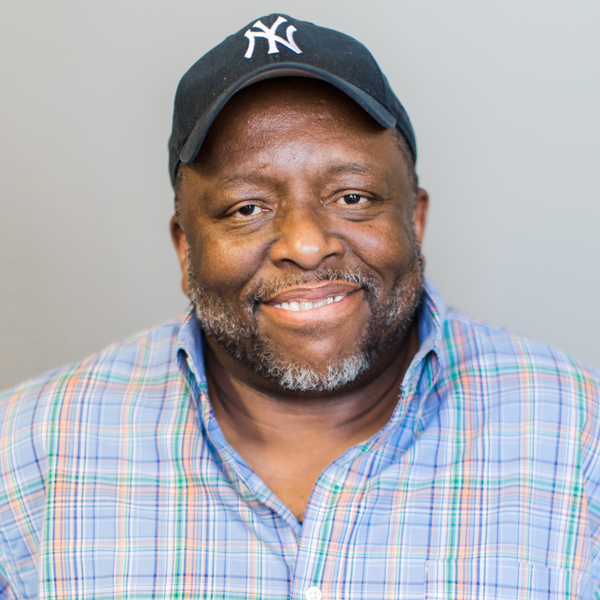
Robert Robinson, a long-term collaborator and Part-Time Faculty member at The New School’s MS Design and Urban Ecologies Program, is a dedicated housing, homelessness, and human rights activist. In this conversation, Robert underscores the importance of building trustworthy relationships with communities to foster deeper engagement and ensure that their lived experiences are at the forefront of our work, thereby creating mutually beneficial partnerships.
This interview was conducted as a part of ‘Community Engagement 101,’ A project by Evren Uzer (PI), Cynthia Lawson- Jaramillo and Michele Kahane. This interview took place on 19th July,2022 remotely over Zoom with interviewer Angelica Calabrese.
Can you tell us about your professional background and the work you’re currently involved in?
My name is Robert Robinson. I have two part-time day jobs. I teach in the MS Design and Urban Ecologies program at The New School. I teach a colloquium called Radical Urbanism, where we introduce students in an architectural program to events in a community. The idea is to engage community input and community-based organizations in the redesign of a particular community. I also work with the Human Rights Organization, where I serve as a Special Advisor with Partners for Dignity and Rights, which is New York City-based.
How would you define mutually beneficial partnership and what do you see as the benefits of mutually beneficial partnership and for whom?
I think in a situation where it is truly mutual, both sides benefit from an interaction, from collaboration, and from working together. There is no extractive side of that equation. Generally, there is a thought process that people in universities can come into a community and look to build theory based on what has happened in the past and what is happening now, but generally, they turn around and walk away, using it for research and to create other projects. I don’t feel that’s an ideal situation. I feel the ideal situation is a participatory situation, where there is an agreement by both sides that it’s going to benefit both. That can happen in many ways, such as through a participatory research process, where we engage together on a regular basis.
I do think the important part of it is for the academy, or the university in this instance, to come into the community. Generally, you see the way these operate is where the community comes into the university constantly.
And that’s sort of one-sided. How can you truly view what is happening in a community if you don’t visit said community? So, I think it’s important for the university to go into the community, and I think it’s important for the community to come into the university. I learned this process from an academic by the name of Neil Smith, a distinguished professor of geography and anthropology at the City University of New York Graduate Center. He always told me that learning is a reciprocal process; it is a wheel that keeps turning. The university goes into the community, the community comes back into the university, and then it’s mutually beneficial. I think it has to include active listening. You have to understand what is going on on both sides. Nobody has more knowledge than the other; both are looking to learn, so it’s a give-and-take situation. And in the end, if you’re successful, those collaborations continue for long periods of time.
How can mutually beneficial partnership be achieved? Based on your experience both as an external partner and working within the university, what do you see as the dispositions and skills, essential to successful partnership?
I think one of the skill sets is understanding history. And what do I mean by that? There are perceptions that run through communities that, as I said earlier, academia extracts; it’s an extractive process. If you understand that this is going to be rejected by the community, I think you’re in a better place. It is about sitting down, coming to an understanding, and establishing a process—maybe even a benefits agreement. It might seem a little formalized, but if you lay out the guidelines at the beginning, I think your process is going to be much easier.
It’s important to understand that it’s not a one-sided thing because a community might sometimes be prejudiced against a university. They might push back and say, “Well, they always come in here and do it this way. That’s not the way we want to do it.” If a community is open and transparent, they should be able to understand that there are skill sets they may or may not have, but these can certainly be enhanced by these types of collaborations.
So, I’ve always taken the approach of being open-minded, sitting down, and seeing if we can work to an agreement. While it does sometimes seem formalized, if you can put it on paper—these are 10 things we want to accomplish—and you can check the boxes as you go along, I think that’s the best approach to take. It’s not going to always be perfect; there will be bumps in the road. But I’ve found in the past that if you can come to those understandings easily—and myself, as a community organizer, having one foot in the university and one foot in the community—I always saw it as a process of taking students into the community. If I’m successful, that student will build trust and won’t need me to come back. I’ve seen that work many times. I take them the first time, trust is built, the reasons why I’m there are explicit, and an agreement is made. That trust and bond are then set for as long as you want it to work.
Some type of agreement you can refer to is important. Hopefully you won’t have to, because it’s so mutually agreeable from the start. But if you hit bumps in the road, you have that document, whether it be an MoU, a benefits agreement, or whatever you want to call it. You don’t have to get too formal with the names, but having an understanding to refer to is crucial. It allows you to constantly check if you are on track. I think it is important, especially for people to take a step back, no matter where they work, to do an assessment. Is this making sense? Do we need to change our strategies and tactics?
These are ongoing conversations that need to be revisited from time to time. That reflection and assessment process is really important. I think it’s often neglected to the detriment of organizations and their relationships with universities. I’ve seen it fail because nobody took a step back to ask, “Does this make sense?” They were directly going in and stepped on the gas, moving forward without reflection.
If you take the time to do an assessment, you might realize, “This is not working. We’re in constant conflict. This doesn’t make sense.” You need to be cognizant of this and honest, open, and transparent. Say, “Listen, we thought it would work this way. It doesn’t seem to be working. Should we try something else?” It’s okay; it’s not saying you failed. Nothing is perfect. If everything was laid out in stone, the world would be perfect, and the world is far from perfect.
How do you employ pedagogical approaches in your classroom to prepare students and communities for collaborative processes like course corrections and reflective practices?
In particular, I like to bring community members who have lived experience into the classroom. They were in that struggle that we’re working on; they found themselves dead center of that struggle, or they know people who are involved in that struggle. I think that’s an important part. I also think a mixture of people who come into the classroom and participate—like policymakers: Why did you make this policy? Why did you feel this policy was important? Did you engage with the community? So you want to bring in all sides to an issue to explain rather than create imbalance or debates—though debates are good; sometimes you have to put it on the table and discuss because people don’t understand why the policy decision I or we made was wrong. And then the community doesn’t necessarily understand why the policymakers made that decision when they wanted another decision.
One of the benefits, I think, is that it’s important to hear all sides of the story. I’m a big fan of bringing in people from the community that participated in these processes that are making policies that are legal. I think it’s really important when you talk about policy—policy sometimes is a reflection of law, right? And I think it’s important to bring legal minds into a classroom to understand because a lot of the decisions that are made are rooted in a constitution that is old language. As I work a lot internationally, and when you go into the international world, and you see these newer constitutions, there are guarantees that don’t exist in the 400-year-old US Constitution.
So while a community might be yelling for change, understand that those policies are rooted in a 400-year-old constitution, and maybe there’s a bigger issue that we need to be addressing, such as whether or not we can amend the Constitution. I think it’s the approach to do a lot of reading history. I would argue that for myself as a community organizer and activist, working with a group called Picture the Homeless, I was invited by many academics as they would hear me speak publicly, and they would give me books or certain texts to read and say, “This was written in a certain time period. They were doing work 60 years ago, similar to the work that you’re doing. You should understand the reasons why they were doing it, or the reasons why it didn’t advance.” So history is a big part of it—you want to make a connection from the historical, the lived experience, and what is happening now; what are the linkages, and I think that’s something that’s important.
It’s not just all about now; how did we get here? You have to understand how we got to this place. If you’re going to unpack a situation or you’re going to dismantle a situation, you have to know how it was constructed.
How can universities effectively ground community engagement by redirecting resources to partner communities or enhancing accessibility to those communities on a sustainable basis? What successful examples have you observed in accomplishing this?
I’ve been blessed as an organizer and activist to be mentored by what I like to refer to as progressive members of academia or activist academics, and some people hesitate with that term—you can’t be that. Well, why not?
My biggest mentor, Neil Smith, always said to me, “A university is there to support the community. Use it to the best of your ability.” Universities have rich resources, whether financial, human, or technical, that communities don’t always have access to. So, how do we share? I’ve seen repeated meetings at the City University of New York Graduate Center; they open up the space. You can always meet here, so there’s always somebody we can connect with within that Graduate Center to have a meeting. They have all the technical equipment; community-based organizations may not have the technology that a university has. So, if you want to put together a gathering and project it out to communities across the country or globe, well, you have the infrastructure within the universities to do that. Those relationships are important.
I also think, from time to time, there are collaborative grants. I know I was a scholar through the Mellon Foundation at the Grad Center for a couple of semesters. It gave me the opportunity to get a high level of education. I have an undergraduate degree, but through that Mellon funding, I was allowed to work as a fellow at the Grad Center a couple of timwa. Those opportunities are open through fellowships and collaborations like that through philanthropy, which you may not see in grassroots organizations. The Mellon Foundation has a big foothold within academia across the country, and it’s an opportunity to give people a springboard into deeper education at a higher level.
What suggestions or recommendations do you have on how university community partnerships can more effectively leverage and redistribute resources.
I think having point persons—maybe there’s somebody within the university that is a point person to the community. That doesn’t always happen, so there’s a frustration level when a community representative wants to reach out to a university and they have to go through the bureaucratic maze.
I know I speak a lot in terms of “I,” but I feel fortunate as a community member to have the relationships that I have at the CUNY Grad Center and at The New School. So, I’m blessed to have two entry points; not everybody has that. And it just makes life easy. When you have a relationship with folks inside both universities, it just makes it so easy to navigate the bureaucracy. It almost became humorous because there is a very large room at the Grad Center where sometimes you want to hold an event for 250 to 300 people.
There’s a room—I forget the name of the auditorium right now—but they generally will not give it to you more than once a semester. There are stories that go around the Grad Center that say, “Well, Rob seems to continually have access to this room,” and I would say that’s because of the relationships that I have with a lot of professors and staff at the Grad Center. They know what I’m trying to do and who I work with, and they make that space open. So, relationships have always been a huge part of this. How do you build those relationships and how do you build trust within those relationships? That the person you know you can ask and you know what’s going to be done if it’s available. It’s not easy, right? It comes with practice.
And sometimes you may be asked as a community member to come into the academy, and you have to learn to say yes. You might be fearful of it. There is some pushback when you go into a community and you say, “Okay, we’re going to hold this meeting at the Graduate Center or at the university.” They might ask us for ID, but that’s a process. If you have a liaison, somebody who can explain that process, it makes it a lot easier. It helps to build those reputations because I do think I’ve always taken the approach that there are challenges on both sides of this equation, but somebody has to be in the middle that can work both sides of the floor to bring people together to make a long-lasting relationship. So, whoever that liaison is, I think it’s a huge job.
Could you elaborate on the importance of relationship building and trust building in community-university partnerships?
I think if people cannot trust one another, it’s impossible to work together to accomplish anything meaningful. That comes over a period of time; just because I say I’m honest doesn’t necessarily mean I’m trusted or that I’ll build that relationship. Actions speak better than words, so show up timely, honor your commitments.
I don’t know if you know my prior history; I’m formerly homeless. There’s a narrative that precedes homeless folks that they can’t be trusted or make commitments. That’s been central to me because I don’t want to be painted with that broad brush.
So when I say I’ll be there, I’ll be there, usually early. When I commit to something, I complete it. Honesty and transparency are key. Can we do this better? Yes, we can. Maya should sit down and figure out a better process.
We should accept critical analysis. Some people curl up in a fetal position when criticized; you can’t be that way. Accept criticism along with accolades and meet somewhere in the middle to figure this all out. Relationships and trust are huge; they’ve been central to all the work I’ve done. I believe that’s why I’ve been successful.
You can’t be on the defensive all the time; active listening is key. Listen, then give your comment. Don’t be defensive; you won’t get anywhere. Be willing to listen and open your mind. It’s hard for some, but with practice, it becomes part of everyday life.
How do we set young people up with the skills to build relationships, the skills to listen, the skills to collaborate, the humility to come into a new community, with a willingness to learn?
I will say, there is a different youth today. And what do I mean by that? I don’t use the term to be offensive; many of the students that I work with are half my age, and I enjoy the collaborations and relationships that I’ve built working with students at The New School. Many graduates of the Design and Urban Ecologies program graduated as far back as 2013/14, and they still work with me on a regular basis or reach out to me. So, that’s relationship-building, that’s trust -”He gave me good information and pointed me in the right direction.” Understanding your privilege, if you have it, understanding racial equity as it may or may not exist in this country, having those conversations is always difficult. Understanding structural racism that exists in this country and explaining that—what I found fascinating all the time in the DUE program—is the students who would come from around the world and did not necessarily have a deep understanding of racial inequity. Here I am, an African American, sitting down with these students and trying to explain racialized housing in the US over a period of time, and you get these incredible looks, like they just can’t believe it. But they’ve come from a country where they didn’t have the racial divide. Having those conversations, and sometimes they were uncomfortable, and probably one of the most uncomfortable that it was, was from a Black student who was from Nigeria, who was in the program in 2013. This was my early days—I wasn’t formally teaching, I was just mentoring students, and occasionally, faculty would send a student to meet me individually. You know, I sat in this very office and then had a two- or three-hour conversation with some of those students, and they walked away very excited and inspired. So, I think the willingness to share that information coming from somebody who experienced it and lived it, I think, has a lot of value. It can’t be disputed. But also understanding your own privilege, and that’s the fascinating thing that I pull away from the DUE program. These students of particular means going into communities that are less fortunate and collaborating with them and really building relationships.
I think the relationship part of it is huge; it comes over time, it comes with trust, but that is built over a period of time. But to institutionalize that, you have to reach into a bag of stuff, in a bag of history, racial inequity, racialized housing, if it’s pertaining to housing, but you start to see these racial inequities permeate other issues, right? But they’re all connected in a way, I like to say. So you can often bring in speakers that you don’t generally. It’s an architecture program, but I’ll often bring in somebody who’s working on immigrant rights because it just reinforces the problems that exist in the community.
What is the most important message that you would send to faculty interested in collaborating?
Understand that community people with lived experience are experts. That’s where the knowledge base should come from. You’re there to support and complement any solutions they may come up with, but it’s a collaborative effort. I also say that practice and research go together. So, what do I mean by that? I’m well known for my background of doing direct action and civil disobedience, but it also has to go with theory—practice and theory going hand in hand.
There has to be a combination. Why are you doing this direct action or civil disobedience? Because we’re highlighting a law or a policy that is unjust, and we’re hoping to draw attention to this and maybe collaborate with the university to figure out a way to rewrite this policy. So, I would just say keep an open mind, collaborate, and be willing to go out into the community. Don’t constantly try to force the community to come into the university; it’s uncomfortable for many of them. They’re intimidated by it. But your relationship builds a lot quicker when you take those steps—you know, take the high road and go out into the community. I just think it means so much to people in the community, and you know, while yeah, I’ve always led a contingent of students—I’m known for bringing students through communities. It comes to a point where students bring these relationships by themselves, building themselves the trust with the groups I introduce them to.
Being open-minded and being intentional about it are important.
What are certain strategies, techniques, approaches and skills for international collaboration?
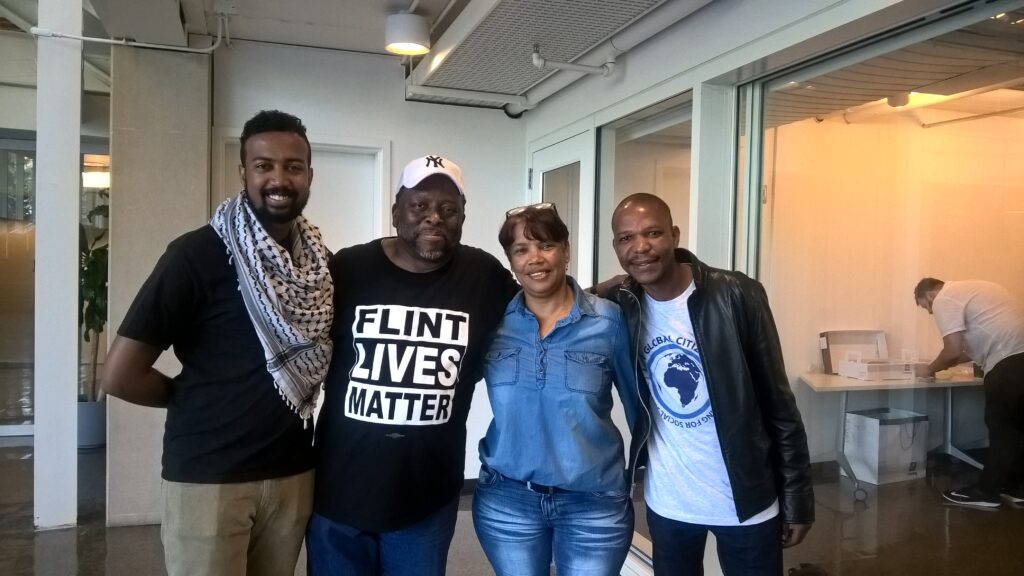
I coordinate globally the International Alliance of Inhabitants. It’s a 12,000-member worldwide alliance that stands on a zero evictions platform. During UN Habitat in 2016, we all went to Ecuador for the event. There was a separate community-based event at a public university because we disagreed with how UN Habitat handled the Sustainable Development Goals over 20 years. “You mentioned this started in 1996 and by 2016, the issues were still being discussed without much implementation.”
Okay, so we needed our own separate forum.
Easier said than done. Mapping certain qualities globally was a necessary skill set. Students from the Design and Urban Ecologies program worked with alliance members who lacked experience in mapping evictions worldwide. Overnight, two students created a PowerPoint demonstration compiling global eviction data. I was amazed: “How did you do this?” It showed their commitment. I have a relationship with these students; they have skills. I’m also a member of this alliance and needed their support—it’s a reciprocal win-win.
Then, we went further south to Guayaquil, where 800 families faced eviction from land they lived on. They sought our support, so we held a public tribunal on evictions. The police commander initially tried to remove them, but international members, including students, negotiated successfully. Today, those families still have their land; one leader, Patricia, is now an elected official in Guayaquil. The students gained firsthand experience and showed how our knowledge can benefit communities worldwide—not just in New York City or the U.S., but also in Ecuador.
In Colombia, during the World Urban Forum, we criticized development approaches we disliked. We advocated for cooperative development, mutual housing, and access to land, contrasting with UN Habitat’s views. Students saw they could challenge big government-backed organizations like UN Habitat, using their mapping and storytelling skills. They collect stories and juxtapose them against eviction data, creating impactful storytelling projects. This program is valuable because many communities see data collection as surveillance. We teach that data can tell stories and uncover issues—it’s not a dirty word.
The program’s big takeaway [in terms of external collaboration] is how we use data. Since 2016, two Ecuador project creators graduated, but members of International Alliance of Inhabitants want them back for new projects. They remember the impact of those students, who left a lasting impression when they presented their work—everyone was impressed, wide-eyed like kids at Christmas.
How do you ensure that academic language is easily understood by community members without losing its complexity and depth?
We tend to use certain language in human rights where I exist, and in academia, that often, when I bring reports out to the community, Rob, translate this—I don’t understand it.
So, language and language access is a big part of making this work. Language that’s easily digestible. Sometimes it’s hard for us, but we have to be conscious of it and cognizant of it and start to lay off language that everybody can understand. Sometimes it’s about simplifying it for us, but don’t be offended by it. I was blessed to be brought into academia, I’m not intimidated by the language, [we need to find a common language]. So that again, reinforcing that liaison role, somebody who can work with you to change the language. I’ve often found myself in that role where I work.
How do we create a shared sense of belonging with the community?
With this master’s degree program, students generally, with a thesis, will produce outputs. Whether that’s a zine, sometimes it’s a website, some tools that they can hand off to the community. “We worked together for two years, here is a synopsis of the issues in your community in the two years that we worked.”
This past September [2023] was the first time I worked with the new group of students. And they created a website for a group in Brooklyn. We created, we all worked together and collaborated with what you want [as the community]. We are not trying to own this website, it’s all yours. So, I didn’t parachute in and extract. You know, I might have parachuted in, we shared some knowledge, but I dropped you off a gift. So, just thinking in that terms and every year, you know, the DUE program, they created publications, zines. A lot of times I still have many copies of it that I will take in the community.