
In Conversation with Tamara Oyola-Santiago
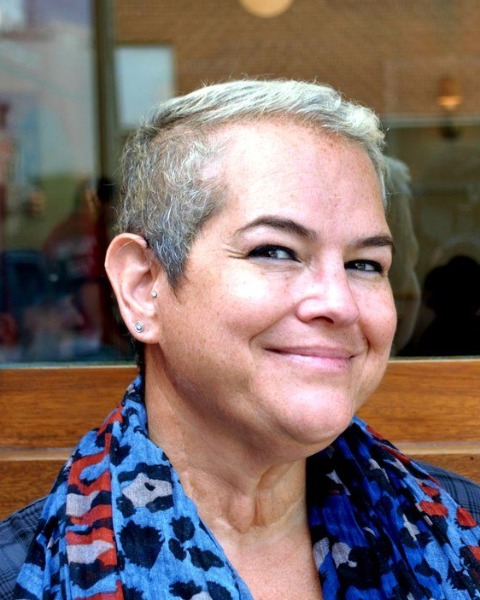
“Curiosity invites us into a process where quality, grace, and mercy can be combined.”
Tamara Oyola Santiago, (she/her/hers/ella) is director, Public Health Services, within Student Health Services at The New School. At the time of this interview, she was co-director at the Institute for Transformative Mentoring (ITM), which is part of the Center for New York City Affairs and the School of Public Engagement at The New School. In this former role, she helped design, lead and co-facilitate a program for Credible Messengers, students with the lived experience of mass incarceration, or who are systems impacted, and who are at the forefront of gun violence prevention across New York City. In this conversation, Tamara introduces us to a restorative and liberatory practice known as the Circle process, and delves into its implementation within community-engaged pedagogy.
This interview was conducted as a part of ‘Community Engagement 101,’ A project by Evren Uzer (PI), Cynthia Lawson-Jaramillo and Michele Kahane. This interview took place on 20th July, 2022 remotely over Zoom with interviewer Angelica Calabrese.
Can you tell us about your professional background and the work you’re currently involved in?
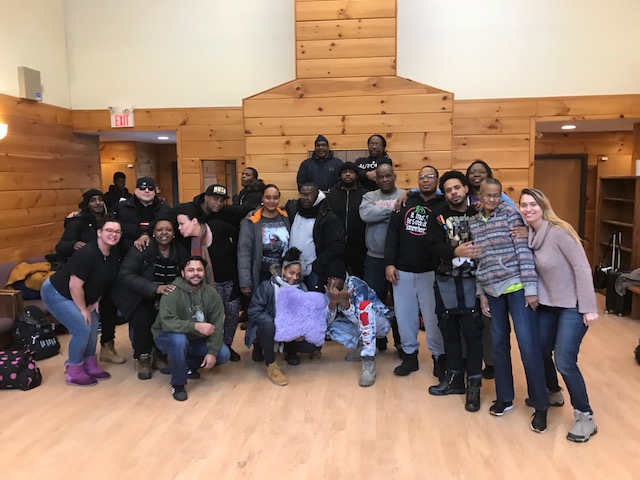
Hello, my name is Tamara Oyola Santiago. My pronouns are she, her, hers, and in Spanish, ella. I am co-director at the Institute for Transformative Mentoring (ITM), which is part of the Center for New York City Affairs and the Schools of Public Engagement at The New School. I help design, lead, and co-facilitate a program for adults who return to the university or come to the university for the first time, who have the lived experience of mass incarceration or are systems impacted. When we talk about systems, we’re talking about racism, sexism, transphobia, and what we call the prison industrial complex. This includes jails, prisons, and state and city institutions. If you think of New York City, it encompasses everything from Rikers to federal institutions, as well as foster care. This is a very unique program within the university, creating spaces that are pedagogical and liberatory, and that invite critical reflection and activism as we work to make New York City a healthier space for all communities and our people.
How would you define mutually beneficial partnership and what do you see as the benefits of mutually beneficial partnership and for whom?
So many words, right? Big words with multiple meanings. My approach is always about how we achieve equality and equity with grace and mercy, and that includes classroom [educational] processes. For many of us, the educational process has been very “banking,” right? If we go back to Paulo Freire’s banking model, it’s where you’re passive and absorb information that gets deposited.
But the truth is, if we want to talk about beneficial partnerships within the educational world, we need to create space for criticism and questioning. We need expansiveness in terms of how we define education, who the teacher is, and who the learner is. When I aim to engage in a mutually beneficial partnership, I want us to come in as equals to the best of our abilities. I want to dismantle credentialism and value lived experience as much as I value my own [academic] experience. What I have found very useful are restorative practices, specifically circles and circle-keeping, as a way to invite non-hierarchical processes into not just the classroom, but in everything I do in life.
Restorative practices invite all of our multiple selves and the knowledge, skills, and abilities that live within everyone engaging in the partnership. Think of the circle, think of the campfire. We’re all kind of gathered around, and it speaks to our humanity. Circles themselves are grounded in indigenous practices. My teachers have been nuri nusrat, Saj Rahman, Cincere Wilson, Ivelyse Andino, and Ashley Elis from The Breathe Collective.
For me, a mutually beneficial partnership is one with non-hierarchical processes. We acknowledge power dynamics but move towards centering the experiences of all involved. We engage together in a dynamic process of critical thinking, reflection, and action building.
How can a mutually beneficial partnership be achieved? Based on your experience as both an external partner and working within the university, what dispositions and skills do you see as essential for a successful partnership?
Successful partnerships are fluid and ever-changing; there is no perfect equation for achieving success. Success itself is defined by the people involved in the partnership process. As a facilitator, teacher, and circle keeper, I have my own agenda and deliverables in terms of course content. However, the other participants have their own goals and objectives when they enter the process.
From the beginning, it is crucial to create spaces where people can share their expectations. Through consensus decision-making, we can collaboratively decide on our vision, how we will achieve it, and how we will check in with each other on progress.
One principle from social justice organizing is that social justice is equal parts content (the vision we are working towards) and process. Both are equally important. You may have an amazing vision and clear goals, but if the process is flawed and people feel devalued or disrespected, ‘success’ will be completely undermined.
We must consider both process and content and recognize that there will be milestones or ‘baby step’ successes along the way. We should celebrate moments where things worked well, knowing that these successes may not always be replicable due to changing group dynamics and evolving participants.
In the context of a university, where courses have specific learning objectives and core content requirements necessary for credentials, the challenge is to balance structure with flexibility. As faculty members, administrators, and facilitators, we should thoughtfully consider what aspects of course design and delivery can be flexible.
Creating spaces for engagement throughout the course, not just on the first day or week, allows learners to contribute as equal participants to discussions and the overall learning process. This approach challenges the rigidity of the traditional banking education system, which is part of the oppressive nature of the education system.
We should strive to make the educational experience liberatory for all participants by incorporating flexibility in design, content, and process. Through this training and conversation, we can explore ways to achieve this goal together.
Can you describe in detail your work at the Institute for Transformative Mentoring?
The Institute for Transformative Mentoring (ITM) uses restorative practices in our pedagogy at the university.
Our students are youth between 18 and 24, and adults who are credible messengers. We define credible messengers as people who are systems impacted, often with the lived experience of incarceration. They are in the trenches, working to dismantle the oppressions of the criminal justice system, while simultaneously role modeling how to be empowered bystanders to stop gun violence.
Together, we engage deeply with each other and with content on social determinants of health, the prison industrial complex, and what it means to be trauma-centered as we engage with youth mentorship. We activate something called the Cure Violence model of public health, which treats gun violence as a disease.
Our model presents political theory and higher education concepts, such as major philosophies and social constructs. How do we unpack all of this? We personalize it. For example, we may present what racism is, the legacy of slavery, and examples of activism. Then, we discuss how racism has impacted our lives. We do the same with sexism and mass incarceration, etc.. This model of story-sharing activates theoretical knowledge and concepts, making higher education a personal journey of liberation and healing.
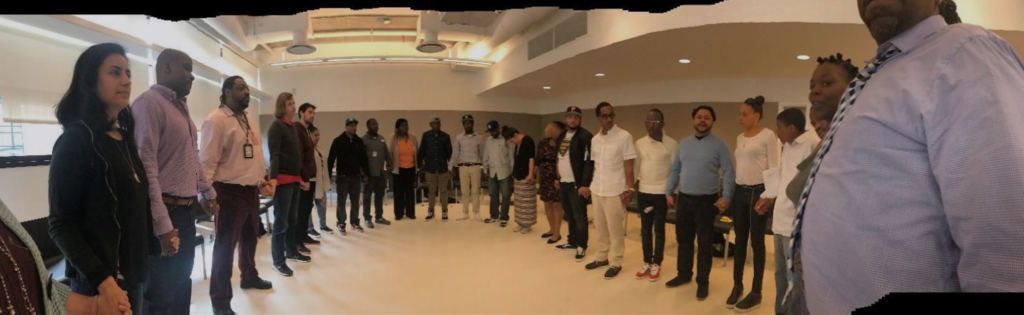
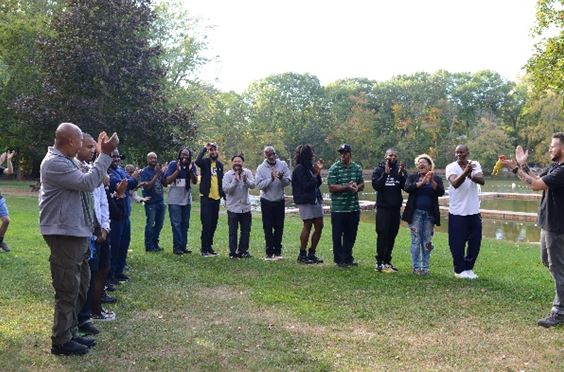
We have found that one of the best ways to do this is through the circle process. The circle is an indigenous practice that has been activated throughout time. We acknowledge that higher education is co-opting an indigenous practice for spaces not originally intended. However, we do this with compassion, grace, and by honoring the indigenous foundations and knowledge keepers.
A big thing happening in higher education now is land acknowledgments, which are part of the circle practice. At ITM, on day one of class or the first workshop, we do a land acknowledgment. We specifically name that we are on Lenape land at The New School. We also explain the origins of the circle practice. Every single time we meet afterward, we start the class with a reflection—be it a meditation, mindfulness, or a breathing exercise—that connects back to day one and the land acknowledgment.
We do this each and every time we meet because it’s important to ground the participants in the pedagogical process and prepare them to go deep into the content together. Given the busyness of our lives, creating a mindfulness-based start is crucial as we embark on a three-hour class.
I want to emphasize that ITM’s approach is grounded in restorative practice. There are essential elements of restorative practice and struggles that I want to share with you because they significantly impact the day-to-day classroom experience.
So, these are the elements of a circle. These may change depending on whether it’s a one-time circle or a recurring one. However, for the most part, within ITM and the work we do at The New School with credible messengers, these elements are activated every single time we meet.
First, we have the icebreaker. As people walk into the classroom, whether virtual or in person, there’s music playing to create a different, welcoming space. Then, there’s a greeting: “Welcome. We are here. This is what we’re doing together today. This is the purpose of the class and today’s session.” This serves as a refresher and reminder.
The opening and land acknowledgment may differ in nature and breadth depending on whether it’s a one-time event or a longer engagement. This is where we honor the indigenous practice we’re activating during our time together. As circle keepers and teachers, we must do our homework ahead of time.
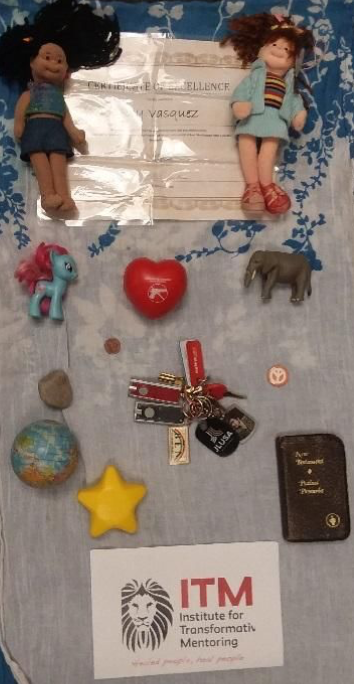
The circle also involves something we call the talking piece. In the virtual world, it’s symbolic, but in person, it’s an actual object passed from person to person. In higher education, we emphasize one mic, one person at a time. The talking piece ensures this by literally indicating who is speaking, with everyone else actively listening. It creates a pause, preventing back-and-forth dynamics, especially during discussions or disagreements. The circle moves to the left, following the cycle of the sun, so you don’t get to talk until the talking piece comes to you. This pause can change your initial reaction by the time it’s your turn to speak.
In the middle is a mantle, which becomes symbolic in the virtual world. In an in-person classroom, the mantle holds the sacredness of the space. We want to honor that the classroom is a sacred learning space. This might be different from typical higher education, but if we aim for liberatory pedagogical processes in partnership with each other, these elements of the circle help achieve success in both process and content.
We also discuss community agreements, which may involve brainstorming or refreshing the values we hold together. Then, we get to the check-in. All these initial elements are about getting to know each other and creating an environment conducive to pedagogical success.
The check-in serves as a reminder of who’s in the room. For example, I might say, “My name is Tamara, my pronouns are she/her. How are you doing today from one to ten and why?” This helps everyone learn the names of their peers and notice if someone is missing.
The discussion round presents the main topics, whether theoretical or action-based. After big topics, we create circles where people can check in and share how they’re processing the information.
Finally, there’s the checkout or closing. At ITM, we always close with “healed people heal people,” reminding us that our classroom work is about both community knowledge and personal healing. Our individual actions are connected to the macro, systemic level.
Each classroom or community experience might have a different closing, appropriate to that community. It could be a call-and-response, a breathing exercise, a movement, or a stretch—anything that signifies closing the session together as we prepare to return to our other tasks.
Could you share in detail about the circle process ?
So, these are the elements of a circle. How do we activate these? We want to be able to present examples of how we would do each of these, knowing that these are not necessarily the only ways to do it. But we want to bring examples into this process.
An icebreaker is an activity that essentially breaks the ice or relieves tension. These can be done online, like a scavenger hunt where participants find something blue, their favorite snack, or share something valuable or loved from their house. We can activate these in different ways to engage everyone via chat.
Next, the element of a circle is the welcome and purpose. We discuss why we’re gathered and the goals of our time together. As circle keepers, we use this term instead of facilitators in our restorative practices. Depending on your context, it might be facilitators instead of circle keepers. We also acknowledge who is present—community members, faculty, or students—allowing everyone to engage with each other from the beginning to address any power dynamics.
Moving on to the opening and land acknowledgment, it’s about recognizing whose land we’re on and the ancestors we appreciate as we gather. This is part of our homework as circle keepers or facilitators: knowing and centering the history and legacies of our communities. We need to understand local context and practices when honoring the land and its people.
Here’s a picture of a classroom experience with a talking piece—a significant item shared by students over the years, placed on a piece of cloth symbolizing the mantle. In our ITM class, students share their talking piece on day one. They may leave it with us, stored for them, or take it back. This process of sharing objects of importance symbolizes the importance of every voice and promotes active listening. Starting with the talking piece on day one sets the expectation for a brave space where all voices are valued and appreciated.
Community agreements and values are crucial in a circle. It’s less about agreements and more about what’s needed for participants to be brave and authentic. We ask, “What do you need to show up to class as your full self?” We avoid using terms like “safe” or “safer” because we can’t guarantee safety, but we encourage vulnerability and define bravery as the willingness to share while engaging with content together.
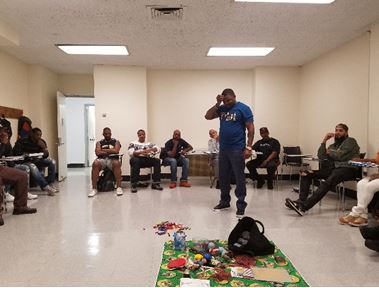
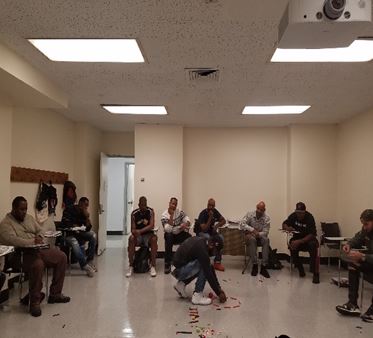
Community agreements should be consensus-driven. This takes time and involves using the circle process with a talking piece, ensuring everyone’s voice is heard. We iterate the agreements until everyone is clear and comfortable, addressing any concerns that arise.
Next is the check-in, which we find important as it grounds us before delving into deep content. Whether online or in person, we use the circle process. In ITM, we ask, “How are you doing today on a scale of one to ten, and why?” We link this to the main topic of the day to reinforce our engagement with the content later in the workshop or class.
Discussion rounds focus on the main topic at hand, such as racism or the legacy of slavery. We might ask, “How has racism impacted you?” These rounds allow for deep sharing and discussion, supporting emotions and creating space for understanding and action.
Finally, closing the circle is essential. As circle keepers, we consider how to uplift and prepare participants for life post-circle. We might ask, “How will you practice self-care today?” or “What brings you joy?” These activities help ground participants and provide closure before they return to their daily tasks.
Each element of the circle process contributes to creating a meaningful and engaging learning experience, promoting both personal growth and community cohesion.
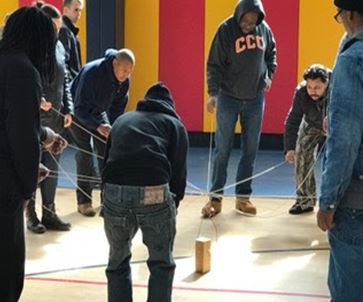
It is interesting to think how the circle process operates across different scales.You can see it applied within a single classroom, but also as a framework for structuring an entire course. Moreover, it serves as a foundation for establishing new collaborations or partnerships, grounding these endeavors with a similar approach.
Absolutely. It’s important to note that people interested in using circle processes need training by and led by experts. This is collective work where we honor our teachers. Similar to preparing for any topic, community experts in restorative practices could offer valuable training for faculty members interested in integrating these methods into their pedagogical frameworks at universities. This approach goes beyond just presenting circles as an alternative—it acknowledges the need for proper training due to the profound healing nature of these practices. In higher education, where traditional methods often prevail, incorporating community justice principles into teaching is innovative and transformative.
How can faculty effectively integrate decolonial methods into community engaged courses, ensuring sustainable university-community partnerships that redistribute resources effectively? What successful strategies have you observed, and what recommendations do you have for improving these partnerships?
The New School is located in New York City. It is a resourceful academic community, and university community members have a passion and commitment for learning and for making New York City great. I have no doubt about that. New York City is vibrant and beautiful. So, I think part of our challenge within the university is to go beyond the walls. And I think, in some ways, the pandemic has shown us that we don’t necessarily need to be on site, on the corner of 14th and Fifth Avenue, in order to do the work of learning, engagement, community action, and reflection. I think that is one of the lessons learned of this very difficult time that we continue to be in – right, we are in the pandemic. That is part of the reality of our lives from here on out. And so, let’s use this opportunity to think expansively of how the university is not just the walls. How the university, in fact, is New York City. It is the Paris campus. It is the outer boroughs. It is this expansive network of international students who have engaged deeply with the university. The university has programs that exemplify the kind of work that we could be doing to support communities that are systems-impacted, that have been oppressed, and where higher education is not accessible due to cost. We have two examples at our university of how we leverage resources for systems-impacted New Yorkers – the Parsons Scholars program and the Institute for Transformative Mentoring leverage community resources, grants, philanthropic donations, etc and make the university more accessible.
What do you think is the most important thing that faculty that teachers that facilitators can incorporate in order to work towards equity in the classroom, and the community?
One of the things that we need to do as circle keepers, facilitators, teachers, professors, administrators—whatever your role is at the university—is that we need to be curious about the world around us. We need to be curious about lived experiences that fall outside of our own.
Once we enter that space of curiosity with intentionality, and with radical love, empathy, and solidarity, then we can be expansive not just in what we teach, but how we teach it. Curiosity invites us into a process where, I think, solidarity and equity can meet grace and camaraderie.