
In Conversation with Gamar Markarian
Gamar Markarian is a multidisciplinary designer and visual storyteller with over 17 years of experience, specializing in planetary-centered design, systems thinking, and community engagement. As a design strategist, she believes creativity thrives through collective effort and has spent 8 years with Philadelphia Mural Arts, facilitating community-driven projects. Gamar values inclusivity and collaboration, weaving storytelling into her work to connect people, ideas, and places. She is currently a Principal design strategist working on delivering digital products and services that people love! She also teaches in the Strategic Design and Management (BBA) program at Parsons The New School for Design, where she coordinates the Design Research 1: Methods course. Gamar herself is a graduate of the MS in Design and Urban Ecologies at Parsons. Outside of work, she celebrates her heritage through cooking and finds joy in creating new friendships and meaningful connections.
This conversation took place on January 15, 2025 with Gamar Markarian and Evren Uzer remotely, and the transcript is edited for the Community Engagement 101 project and the Collaboratory website by Soraya Barar.
Can you please introduce yourself briefly?
My name is Gamar Markarian. I am a design strategist, and have worked with and in community engagement, social justice and innovation spaces. I am also a Parsons alumni and part-time faculty teaching design research methods including collaborative design.
Would you please talk about your practice and the projects that you are working on currently?
I practice what is known as socially engaged art. In this context art has a broader definition and includes design as well. Specifically, what I do is collaborative design for a more just future, specifically within urban settings. I am going to be talking through two different projects I have participated in with Mural Arts Philadelphia, but I want to acknowledge that these projects do not come to life because of the brilliance of one person but because of the involvement, participation and “treasures” of many people. The first project is a case study, written in collaboration with Beth Enson, Shari Hersh, and myself. At Mural Arts we spent a great deal of time and resources in selecting the sites for our projects and the majority of these projects are identified by the needs of the communities themselves.
The first project, in South Philadelphia, is a co-participation and co–production project from start to finish, engaging with people in what we call grassroots collaborative research and design using gameplay. This second project is situated in North Philadelphia in the Cramp School and is called Uprooted/Rerooted. The project adopts a collaborative model of working with the community. The project stemmed from the need for green spaces for people to gather in with their families. So the first project is focused on collaboration through gameplay and the second project is heavily reliant on collaborative artistic process.
An important driver of our work is that the foundational improvements to urban fabrics must emerge from the communities themselves. This approach is paraphrased from curator Lucia San Roman as well as William Goldsby from Reconstructing Rage. The second guiding principle of our work comes from David Harvey and the necessity to move from individualism to collectivism and the belief that the work to changed our cities must be communal.
In order to stay true to our guiding principles we write our values down to reference throughout the project. Creativity is a communal endeavor so collective authorship of all this work is very important to us. While we do this work, we focus on community capacity building, at the same time, we recognize everybody’s skills in the circle and honor community expertise. We also intentionally create a community hub, which is a physical space where we meet, eat, and work together. Additionally, we like to complicate a topic, so we introduce a variety of perspectives into the conversation. Since Mural Arts is an arts organization, we believe that the intervention should be creative in order to provoke and shift mindsets – and art, as a medium, does that really beautifully. Our projects start by sharing our knowledge base and along the way we make friends, and we build relational networks.
Southwark: Our Park
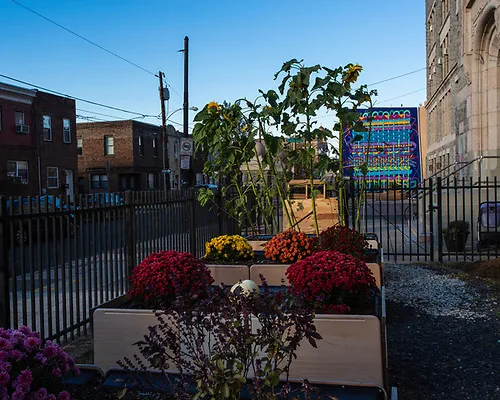
Our timeline for these kinds of projects can look pretty long usually. The official timeline for Southward is from 2015 to 2020 which is a 5 year span. However, mural arts had a presence in South Philly and had been active in the community prior to 2015. So, we intentionally remain and collaborate with communities for long periods of time because we acknowledge that change happens on a lengthier timeline. A longer timeline also helps create friendships and relational networks that are such an essential component of community engagement work. If you don’t build that trust, or friendships with the people that you are working with, something breaks.
Community engagement in the Southwark project was particularly impactful because of the way that we used gameplay throughout the project, every meeting was a game, as well as how we, together, exercised our right to the city and practiced collectivism.
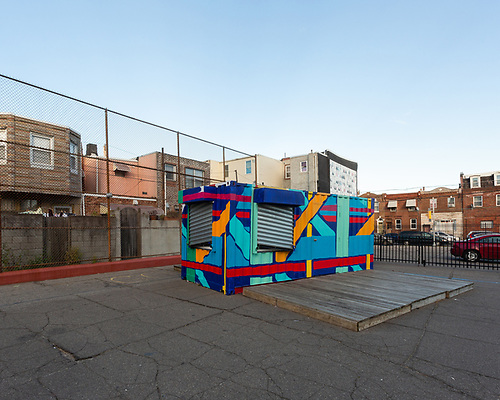
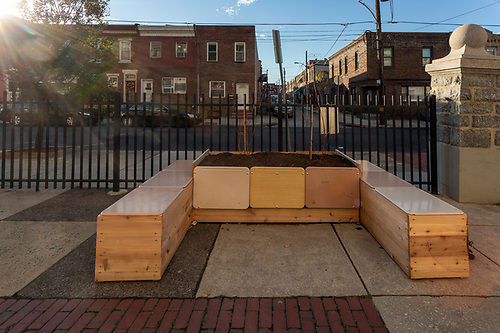
Through gameplay we are able to transcend cultural barriers like language and allow for true intergenerational negotiation and discussion that wouldn’t otherwise be possible. In this specific project it really fostered true citizen participation when deciding what the space and schoolyard needed. The goal for this project was for us to come together to think of a vision for our space and neighborhood to increase greenspace, and design the space collectively. This game not only created community, it made us friends and it allowed us to design according to democratically agreed upon needs and desires. The project physically consisted of a new schoolyard, built in two phases, as well as a community designed mural wall.
In our work in South Philly we deployed multiple methods of collaboration. Even before diving into the space, we relied on the Playgrounds for Useful Knowledge project that CohStra has developed. In that project, there was a wealth of information generated with the community about the community for the community. So it was necessary to understand that context before going into this space. Before starting the project, we asked people about their skills and treasures; what they can and want to bring to the group. Some folks would say, “I’ll help in construction” and others would say “you know what, I am a really good cook”. So we gave community members something like one hundred dollars a day to cook for the whole group, bring us food, and eat together. This was a really important part of bonding and getting to know each other and building that necessary trust. We also did a series of exercises with the South Philly community to understand who they are, what is the makeup of the community as well as to introduce ourselves. This is really where the friendship journey started with everybody.
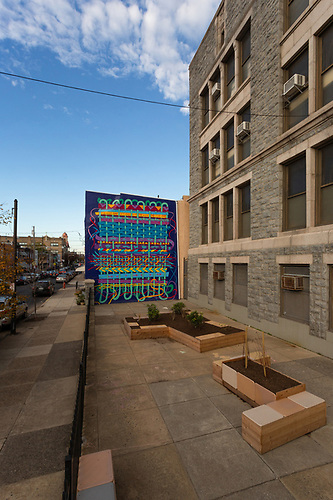
Once we understood the context within which we stood, we had the building blocks of the game itself. The questions asked in the game as well as the way that the game was designed remained a reflection of the community. Through the game, we were able to translate the ideas into a design of the space, we got feedback and made sure that we were all okay with these ideas. Our partner for this project was Trust for Public Land who was tasked with implementing the schoolyard. As we were getting ready to start construction the community said, “we are not ready to stop this work”, “something more needs to happen”, “let’s continue building this community, let’s create more collectivism”. When they said this, I remembered this design collective in Spain called Basurama that does very similar work, building communities through the building of physical spaces using “trash” (Basura). We then said, “Ok, well since the backyard is under construction let’s look at the front yard.” So we did design charrettes together, designing the front yard with Basurama joining us through zoom. Basurama brought a new perspective to the project that was appreciated by the community and needed in the project. In the process of designing and vocalizing the things that we needed in our city spaces we exercised our right to the city. Through this process community leaders emerge and you start to see who is taking the lead organizing the community. When we work together, in the spirit of horizontal collaboration and honoring people’s expertise, we make sure that this work is not gone uncompensated. But unfortunately, I think we need to build a little more equity in the way that we compensate everyone that is involved in the project.
Uprooted/reRooted
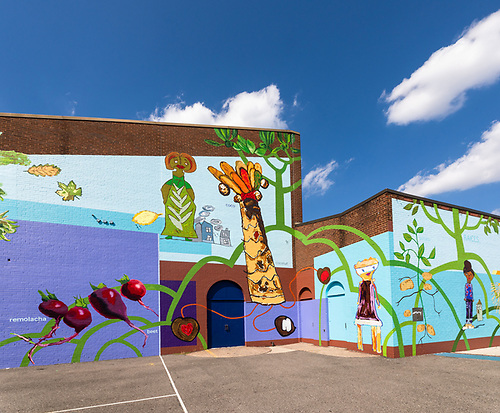
This project has a very similar timeline to the Southwark project, while Southwark was about experimenting with community engagement through gameplay the Uprooted/reRooted project experimented with community engagement through a centralized community hub space. Again, similarly to the Southwark project, Mural Arts had a presence and involvement in this space prior to the start of this project in reconstructing the school’s front yard in collaboration with Trust for Public Land. Uprooted/reRooted was initiated through community vocalizing that they wanted to stay involved in the design of their space, transform another portion of their space, with the addition of murals. So, Mural Arts worked with the community to understand which artist the community wanted to work with and decided to work with Marion Wilson.
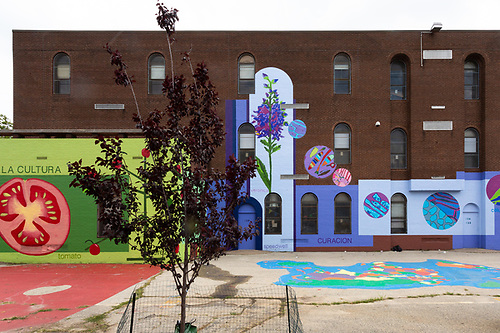
Marion Wilson is a socially engaged artist whose work explores ecology and landscape. With Marion, they designed the north courtyard, came up with a mural design, kept botanical journals, and created a hub space in the school’s gym. The intention of the hub space was to create a shared knowledge base where everyone could gather and meet. The space allowed them to center local experiences and knowledge and made horizontal collaborative making processes possible. Marion would hold classes and meetings in the hub, learning together and sharing together specifically around plants. Through sketching, drawing and collaborative design they designed a mural that wrapped around the entire school.
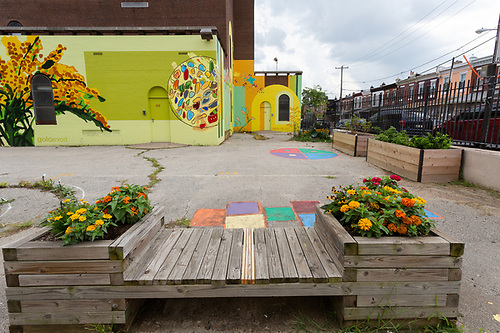
After this project, we remained in the neighborhood. One thing we kept hearing over and over again from residents was that they wanted people to speak about North Philly in a positive light. North Philly has one of the biggest opioid epidemics in the country, but community members expressed how tired they were of being represented in the negative light and wanted to change the narrative. So we asked, “how can we keep building community?” and “how can we keep talking about ourselves in a positive light?”.
We started holding knowledge sharing sessions and started telling each other the positive stories of the community. Stories about change and social justice fights and the ways in which they have already changed and won certain battles in the neighborhood. We asked if we could design a community building game to connect people in the neighborhood to each other so they can actually rely on each other when needed. We asked community members if they were interested in designing this with us, and, again a few community design leaders emerged. So we designed a community building game where each card and contents of the card is based on the information we gather from our knowledge sharing sessions. The cards each have different topics: learning, trust, storytelling, sharing, decision-making, and public spaces.
What I love about this game is that we designed it collectively and that it relies on storytelling and sharing. Round after round you hear beautiful stories about North of Philly and collectively at the end you choose 6 of these stories and you “plant” them in the “garden of possibilities”. This is a way of visualizing the ideas that the community would like to address moving forward. From this game we were able to put together another set of cards where, at an organizational level, any organization can use the cards to make sure that they are in some capacity practicing community engagement.
From the perspective of Philly Mural Arts and the community what does a successful partnership look like?
It is really difficult to measure this type of goal-oriented success even though we do have clear goals in these projects. Especially when you come from an organization like Mural Arts your clear goals are: “is the schoolyard designed?” yes. “Do we have a beautiful mural?” yes. “Were we about to engage the community in order to reach those outputs” yes. But, a measure of success for me personally is when I go back to interview the community and everyone shares the impact that these projects have had on themselves as individuals, the neighborhoods, and on the community as a whole. You can’t quantify that. But going back to have that conversation, serves as a sort of qualitative form of capturing some of the success. For example, a woman who was one of our community design leaders in the Southwark project expressed how after the project, a lot of doors opened up for her in the community. Another indication of success for me is that everytime we “finish something” or a loop closes the community comes back and says “Well, what about this? Can we continue? Can we do this?”, that is success to me. As an organization we have concrete goals that we set, we have intentions that we set, but we do not have a specific success metric for community engagement. The success becomes apparent after the project and upon community reflection.
Can you talk a little bit more about the challenges you faced in these projects? And how do you address these challenges?
I mean there were smaller conflicts or challenges like which spaces to meet in, who are our translators that are going to make this community negotiation across five different languages. Although this isn’t necessarily conflict but more so how can an individual or organization better perform community engagement? I think it comes down to equity and pay. Another one is that, In the past we have done a lot of the planning on our own as an organization, but moving forward in other projects, everybody should be involved in the planning. So things like that where it’s not necessarily conflict but more so how to be better, non-extractivist partners in the community. There is a long journey to true non-hierarchical community engagement and collaboration, there are frameworks that you can build around it, you can have the best intentions but unfortunately inequities still happen.
What do you think, as a practitioner, are the skills and capacities that were beneficial to you for future practitioners to prepare themselves for such engagement work?
The number one thing is to accept that as a designer you put your ego aside and you accept and understand the value of collectivism. Also I think it is important to not be afraid of going into a community that is not yours, but can absolutely become yours, depending on how you approach it. That is why I always emphasize the aspect of friendship and relational networks. When you become vulnerable with the community, they accept you as one of their own, and you build mutual trust in each other. Another thing I teach my students is Donna Haraway’s imposition exercise. The exercise really makes you think of things in relation to each other – it implodes a system of connections around an object or an issue. In community, understanding everyone’s expertise, and passions allows all the puzzle pieces to fall into place.
I have seen multiple community members make fun of the institution’s presence in their spaces. But the less formal these meetings and sessions are, the better. Informality doesn’t mean that you’re winging it – there’s a lot of intentionality in that informality. You show up in a space truly wanting to be friends, not because it’s a chore that you need to do as an institution. This also helps a lot in not being extractivist in your intent and approach.